INTRODUCTION
| Paragraph | ||
| Scope |
1 | |
| Description |
2 | |
| Data |
3 |
1. SCOPE. - a. This technical
bulletin is published for the information and guidance of those concerned
pending the publication of FM 23-7 and TM 9-1276.
b. In addition to a description of the Carbine,
Cal. .30, Ml, this technical bulletin contains information required for the
identification, use and care of the materiel and its component accessories,
including available information on ammunition.
c. Disassembly, assembly, and such repairs as
may be handled using arms personnel will be undertaken only under the
supervision of an officer or the chief mechanic.
d. In all cases where the nature of the repair,
modification or adjustment is beyond the scope or facilities of the unit, the
responsible ordnance service should be informed in order that trained personnel
with suitable tools and equipment may be provided, or proper instructions
issued.
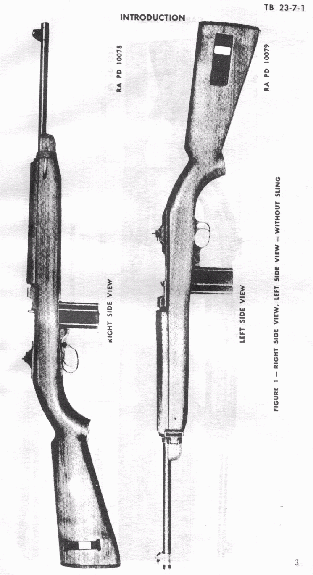
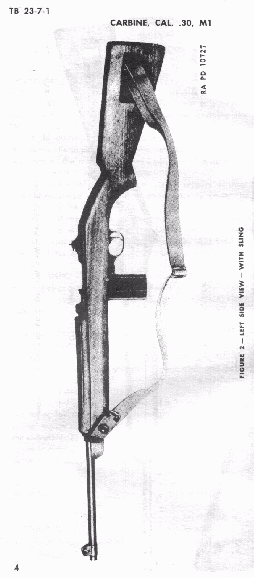
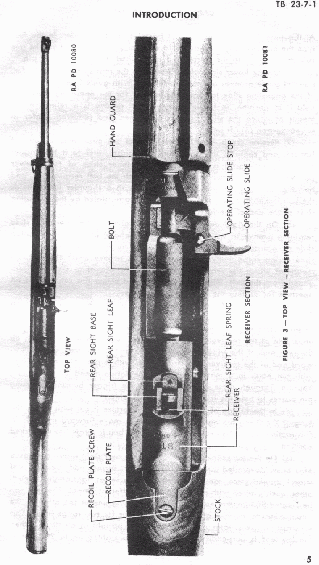
2. DESCRIPTION. - a. The Carbine,
Cal. .30, M1 (Figures 1, 2 and 3) is a
gas-operated, self-loading, air-cooled, shoulder weapon, delivering
semi-automatic fire controlled by the operator. It is fed by a box magazine
containing 15 cartridges staggered in the magazine. The weapon has an over-all
length of approximately 36 inches and weighs approximately 5.80 pounds with
sling and loaded magazine attached.
b. The carbine is in many ways similar in
operation, functioning, and general design to the U. S. Rifle, Cal. .30, Ml,
and, in general, is composed of four main groups of assemblies and ports: the
barrel and receiver, the trigger mechanism, the operating mechanism, and the
stock, hand guard and sling.
(1) Barrel group. - (a)
The barrel is 18 inches tong, cylindrical and without taper for two-thirds of
its length. It is threaded into the forward end of the receiver, and in the rear
face is a cut to furnish clearance for the extractor. To the muzzle end is
attached the front sight group composed of a ring body with on integral blade
positioned midway between two side wings keyed and pinned to the barrel.
(b) A gas cylinder
is positioned on the underside of the barrel near the chamber and contains the
piston, locked in by the piston nut, which limits its rearward movement. A gas
port is drilled at an angle through the gas cylinder and barrel, entering the
bore about 4.5 inches from the rear face of the barrel. This rearward
positioning of the gas cylinder and port makes it possible to take the gas from
the bore close to the chamber, before cooling can take place, thus minimizing
carbonization.
At this time there are two types of barrel and gas cylinder. In
the first type the barrel and gas cylinder are integral; in the second type the
gas cylinder slides onto the barrel and is retained in position by a pin.
3. DATA. --
(c) On the
lower sides of the barrel, to the rear of the gas cylinder,parallel guide
grooves are cut, which mate with guide lugs on the body of the operating slide
to form a guideway for the operating slide and hold it in position.In the left
hand barrel groove is a relief cut, by means of which the slide body is
positioned and removed. (Refer subparagraph (3) (d) below).
(2) Receiver
group. - (a) The receiver is of one piece, open at top and bottom, and
contains the operating mechanism, and to it the trigger housing (mechanism) is
attached. In the inner sides of the receiver parallel bolt guide grooves are
cut, in which the bolt reciprocates and bolt lug locking apertures which are cut
with a shoulder which holds the bolt locked in the closed position when
cam-rotated by the operating slide at the end of the forward movement.
(b) On the
right outer side of the receiver is the operating slide retaining groove in
which the rear end (handle) lug of the operating slide reciprocates when the
slide is actuated by the piston and operatingslide spring respectively. In the
top of this groove is arelief cut, by means of which the rear end (handle) of
the operating slide is disengaged from the bolt. Slightly to the rear and below
this relief cut is an aperture for seating the operating slide stop.
(c) On the
rear face of the receiver is a lug which engages in an undercut in the recoil
plate (mounted in the stock) to lock the rear end of the barrel and receiver
group to the stock. Below this lug, on the underside of the receiver, are two
L-shaped lugs into which a T-lug on the rear end of the trigger housing slides
and is retained. On the forward end of the receiver is a straight tug with a pin
hole which aligns with pin holes in a mating U-lug on the forward end of the
trigger housing. Through these aligned pinholes the trigger housing retaining
pin passes to hold the trigger housing in position.
(d) In the bridge of
the receiver an aperture is cut with which the tong of the firing pin must mate
in order to move forward in the bolt. This mating cannot be accomplished until
the bolt is rotated to the locked position.
(e) On the top rear of
the receiver is the rear sight group composed of a base (dovetailed into the
receiver), leaf, spring, and pin. The leaf is on L-shaped piece, consisting of
two leaves set at right angles to each other, each pierced with an aperture at a
different height. The leaf can be rotated 90 degrees on the leaf pin, thus
positioning one or the other of the integral leaves, thereby giving sight
elevations for two range limits. This construction necessitates one leaf
remaining upright at all times. When the low leaf is perpendicular, the carbine
is sighted up to 200 yards, and when the high leaf is perpendicular, up to 300
yards. (For shot grouping at 100 and 300 yards, refer to paragraph 50
c).
(f) In the under side of the receiver is an aperture into which the magazine
fits, and is retained by the magazine catch positioned in the trigger
housing.
(3) Operating
mechanism group. - (a) The operating mechanism is composed of the bolt, the
operating slide, operating slide spring, and spring guide. The bolt operates
within the receiver, and the operating slide in its grooves on the right outside
face of the receiver and lower rear faces of the barrel.
(b) The bolt contains
the firing pin, extractor and ejector groups and is connected to the operating
slide by a lug on its right side, which mates with a camming aperture in the
left face of the operating slide (handle). In line with this lug, and similarly
placed on each side of the bolt, are locking lugs which engage in the receiver
locking apertures already described.
(c) The extractor is of the
claw type, seated in an aperture in the top of the bolt and actuated by a
plunger and spring. The ejector is seated in a well in the lower port of the
bolt, locked in by the extractor, and actuated by a spring. The firing pin is
seated in a well in the center of the bolt, is locked in by the extractor and
has a tang on the rear end which blocks it from functioning until the bolt is
locked, as already explained.
(d) The operating slide is
composed of an integral body and (retracting)handle. The body reciprocates in
its guideways on the underside of the barrel, and the handle in its guideway in
right outside face of the receiver. The function of the slide is to move the
bolt backward and forward unlocking it from, and locking it to, the receiver at
the proper time. The bolt in turn cocks the hammer on its rearward movement and
feeds the cartridge into the chamber on its forward movement. The force to
accomplish these actions is supplied by the backward thrust of the piston on the
recoil stroke and the forward thrust of the loaded operating slide spring on the
counter recoil stroke. The operating slide is provided with a retracting handle
for retracting the bolt. On the shank of the handle is a lug which contains the
afore mentioned bolt lug camming aperture. To the rear of this lug is the guide
lug. The operating slide spring seats in a well in the forward face of the
receiver, and acts on the operating spring guide, the forward end of which seats
in an indentation in the rear face of the operating slide (body). In the rear
end of the operating slide (handle) is a stop operated by a spring. The stop
hangs the bolt when depressed and held into its retaining aperture in the
operating slide (handle) guideway in the receiver.
(4) Trigger
mechanism group. - (a) The trigger (housing) mechanism group is composed of
the trigger housing, trigger, hammer and sear, together with their component
springs and pins, and the hammer spring plunger. The trigger housing is attached
to the receiver at the rear, by means of a lug on the rear end of the trigger
housing which engages with L-shaped mating lugs on the lower rear face of the
receiver. The front end of the housing is held in position by a retaining pin
passing through mating lugs on the forward end of the receiver and trigger
housing and held in position by a spring. (Refer to subparagraph b (2) (c),
above).
(b) The trigger and sear rotate about the trigger pin and the hammer about the
hammer pin. The hammer spring plunger seats in a notch in the rear face of the
hammer shank and extends through an aperture in the rear of the trigger guard
body, while the hammer spring bears upon the trigger housing and a collar on the
plunger. The trigger spring is a U-shaped spring which fits in a slot in the
rear end of the trigger, and an aperture in the rear end of the trigger housing.
The rear end of the sear spring is seated in a well in the trigger body, the
forward end in an aperture in the rear lace of the sear.
(c) A safety is housed
in the forward end of the trigger housing just forward of the bow. The safety is
in the form of a cylindrical pin with a cut so fashioned that it clears or
blocks the forward end of the trigger when the safety is pushed from side to
side in its aperture. The safety is held in position by the safety plunger and
spring. On the right side of the trigger housing just ahead of the safety, is
the magazine catch. This catch functions in an aperture in the forward face of
the trigger housing, and is held in engagement with two small lugs on the
magazine by the magazine catch spring and plunger. The catch, when pressed,
moves laterally to disengage it from the magazine lugs so that the magazine may
be removed from the receiver.
(5) Stock, hand
guard and sling group. -(a) The stock group is composed of the stock in
which the receiver and barrel are bedded, and the hand guard positioned on top
of the barrel forward of the receiver. In the rear of the aperture in which the
receiver is bedded, the recoil plate is positioned. This plate is secured to the
stock by the recoil plate screw passing through the tang of the recoil plate and
thence through the grip of the stock, and threaded into an escutcheon let in to
the underside of the stock grip. The recoil plate serves to lock the rear end of
the receiver to the stock as here to fore described, and to protect the wood of
the stock from the hammering of the recoil mechanism. A recessed butt plate is
screwed to the butt end of the stock by a wood screw.
(b) To the rear end of the
hand guard a metal liner is riveted, which protrudes slightly beyond the wood of
the hand guard. This liner, when mated with an undercut in the top forward face
of the receiver, secures the rear end of the hand guard to the receiver. The
forward end is secured to the barrel by the front band which slides over the
barrel and forward end of the stock and hand guard, thus securing all three
together. The band is locked in position by a locking spring and
screw.
(c) A web sling is attached to a sling swivel mounted on the left side of the
front band. In the rear end of the sling a loop is formed by means of a metal
button passing through two button holes in the sling (recent style). This loop
passes from the left side around the oiler, which seats in the right side of on
aperture cut through the stock near the butt. The dimensions of the aperture
through which the oiler is inserted prevents it falling out after the sling has
been passed around it. Thus the oiler is held in the aperture by the sling, and
acts as an anchor pin for the rear end of the sling. To the forward end of the
sling a locking buckle is attached, by which adjustment of the sling is
attained, after it has passed through the sling swivel.
NOTE: The
oiler is cylindrical in shape and has a screw top to which a dropper rod is
attached. It is used for lubricating the carbine as well as to hold the sling in
position.
c. The magazine is
composed of a tube, base, follower, and spring. When loaded, the cartridges lie
staggered in the tube and are pushed into line with the bolt, at the mouth of
the tube, by the action of the follower and the follower spring, The mouth of
the tube is narrower than the body of the tube and has its lips crimped inward.
Thus one cartridge at a time is positioned and held in line with the bolt, ready
to be pushed forward and loaded into the chamber as the bolt moves forward on
the counter recoil stroke.
NOTE: 7000 grains equal 1
pound avoirdupois measure.
Weight of carbine with magazine (unloaded)
Weight of carbine with magazine (loaded) and
sling
Weight of magazine (unloaded)
Weight of magazine (loaded) with 15
cartridges
Weight of 100 cartridges
Weight of 1 cartridge
Magazine capacity
Overall length of carbine
Length of barrel
Rifling, R.H., one turn in
Grooves in barrel
Sight radius
21.46
Trigger Pull
4 - 6
Ballistics of cartridge
(Refer to Section VII -
Ammunition)