OPERATION AND FUNCTIONING
| Paragraph | |
| General |
4 |
| To load the magazine |
5 |
| To load the carbine |
6 |
| To unload the carbine |
7 |
| To operate the carbine as a single loader |
8 |
| Individual safety precautions |
9 |
| Rearward movement of the operating mechanism |
10 |
| Forward movement of the operating mechanism |
11 |
| Action of the trigger mechanism |
12 |
4 GENERAL. Operation and
functioning will, for convenience, be divided into two main groups of actions:
the manual operations necessary to load, fire and unload the weapon, and the
mechanical functioning of the mechanisms when acted upon by the force generated
by the expanding powder gas when the cartridge is fired.
5. TO LOAD THE
MAGAZINE. - Insert 15 cartridges into the magazine one at a
time. To insert cartridge, hold magazine in the left hand with the curved open
end up and to the right. Grasp a cartridge in the right hand between thumb and
forefinger with base to the left. Insert base of cartridge in right end of
opening in top of magazine and press down with thumb against follower, forcing
cartridge below lips of magazine. Then push cartridge to left, beneath lips,
until base of cartridge contacts rear of magazine tube. Grasp another cartridge
in the same manner and press down upon the first cartridge and slide the second
cartridge to the left over the first one. Continue thus until all the 15
cartridges are loaded into the clip. The cartridges will be staggered in the
magazine when it is fully loaded, with the top cartridge centered between the
lips of the magazine. If the follower does not depress smoothly, push down and
release a few times. If this does not improve the action, look for dents, rust
or foreign matter in magazine tube, or for bent follower.
6. TO LOAD THE CARBINE. -- a. Insert a loaded magazine into
opening in receiver with the retaining lugs (flat face) to the rear and push it
up until the magazine catch snaps into position, below the retaining lugs on the
rear face of the magazine tube. If magazine does not snap in easily, depress the
catch. Ordinarily this action should be performed with the bolt locked and the
hammer let down. This makes it possible to carry the carbine safely with loaded
magazine attached, as it cannot be fired until the bolt is retracted and allowed
to close and lock.
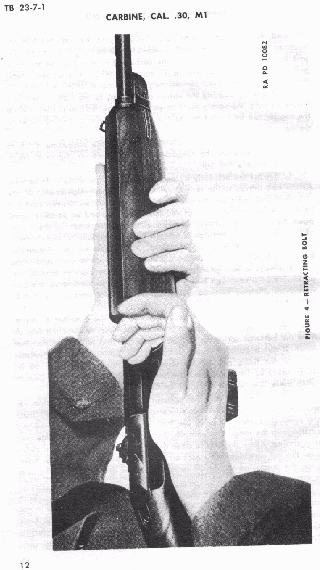
b. With
loaded magazine latched in position, retract the bolt, with little finger
(Figure
4), all the way to rear by pulling back the operating slide handle,
and then allow it to snap forward. Unless the bolt is fully retracted, the sear
may not be seated properly in the sear notch in the hammer. The carbine is now
fully loaded with a cartridge in the chamber and the hammer cocked. To fire the
carbine it is now only necessary to pull the trigger and thus release the
hammer. When thus loaded, unless the carbine is to be fired immediately, the
firing mechanism should be placed at safe by pushing the safety all the
way to the right. When thus placed at safe, the safety must be pushed all the
way to the left before the trigger can be pulled to fire the weapon (For sight
Setting refer to paragraph 2 b (2) (e)).
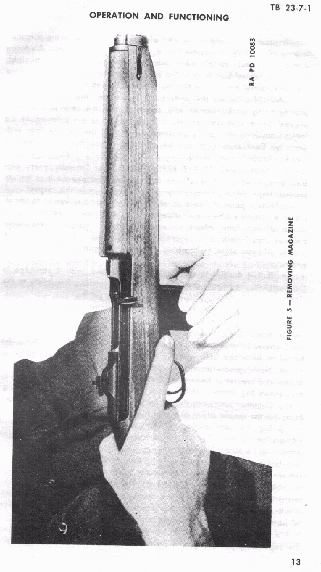
7. TO UNLOAD THE CARBINE.-- a. Press the magazine catch to the left and withdraw the magazine from the receiver (Figure
5). Magazine will usually fall out.
b. Retract the bolt fully by pulling back the
operating slide handle. As the bolt moves to the rear it will extract the
cartridge seated in the chamber and elect it. The live cartridge case can be
prevented from being thrown clear of the receiver by the ejector, and so
possibly damaged, by placing the thumb over the receiver, thus blocking the
throw of the cartridge. If cartridge is ejected freely, it should be wiped clean
of foreign matter before reloading it into the magazine. Examine chamber to see
that it is empty before allowing bolt to go forward and close. This is always a
safe practice when retracting the bolt, to obviate the possibility of a
cartridge being left in the chamber. Ordinarily the bolt should be allowed to
close slowly on an empty chamber and not to snap shut.
c. When it is determined beyond doubt that the
chamber is empty and with the magazine removed from the receiver, remove the
tension from the hammer spring by pulling the trigger and letting the hammer
down. If this is done while the bolt is still partly retracted, the hammer blow
on the firing pin will be lessened and the hammer will be let down easily as the
bolt closes. The hammer should never be so released when there is
a loaded cartridge in the chamber.
d. To unload the chamber without withdrawing
the magazine, retract the bolt, block the extracted cartridge as explained and
lift from the receiver. Before allowing the bolt to go forward, depress the top
cartridge in the magazine with the thumb so that the bolt will ride over it in
closing. Allow the bolt to close slowly, watching to see that it slides
over the top cartridge and closes on an empty chamber. As a rule, however, the
magazine should be removed, unless empty, before chamber is unloaded.
8. TO OPERATE THE CARBINE AS A SINGLE
LOADER.-- With empty magazine in place, retract bolt
fully and place a cartridge in the chamber. Allow bolt to close smartly so that
extractor will engage base of cartridge and bolt be rotated to full lock. Where
noise is a factor, the bolt may be eased to the closed position and the
operating slide handle pressed forward at the end of the movement to insure
complete locking of the bolt. Unless carbine is to be fired immediately, the
firing mechanism should be placed at safe, by pressing safety fully to
right. To unload, retract bolt fully to the rear, to eject cartridge, and
examine chamber to make sure it is empty, before allowing to close.
CAUTION: During the operation of loading and
unloading and placing firing mechanism on safe, the muzzle of the carbine
should be pointed down, and care exercised to see that it is not pointing at the
foot or anything that could be damaged in case the carbine fires accidentally.
Care should always be observed when handling weapons whether loaded or
unloaded.
9. INDIVIDUAL SAFETY
PRECAUTIONS. -- a. Consider every carbine to be loaded until
you have examined it and proved it to be unloaded. Never trust your memory as to
its condition in this respect.
b.
Never point the carbine at anyone you do not intend to shoot, nor in a direction
where an accidental discharge may do harm.
c. Always fully unload the carbine if it is to
be left where someone else may handle it.
d. Always point the carbine up when snapping
the trigger after examination.
e. If it is desired to carry the carbine cocked, with a cartridge in the
chamber, the trigger should be blocked by pushing the safety to the
right.
f. Under no
circumstances should the hammer be let down on a partially closed bolt, with a
cartridge in the chamber.
g.
Never fire a carbine with any grease, cleaning patch, dust, dirt, mud, snow, or
other obstruction in the bore. To do so may burst the barrel or blow the
bolt.
h. Never grease or oil
the ammunition. This may affect the ammunition, and creates a hazardous pressure
on the carbine bolt. (Refer to paragraph
51).
i. Chamber and bore
should be wiped dry of oil or grease before firing for the reason given in
g and h above.
j. See that ammunition is clean and dry. Examine all live and dummy ammunition.
Turn in all cartridges with loose bullets or which appear to be otherwise
defective.
k. Do not allow
ammunition to be exposed to the direct rays of the sun for any length of time.
This creates hazardous chamber pressure.
10. REARWARD MOVEMENT OF THE OPERATING
MECHANISM. -- In the following description of the mechanical
functioning of the carbine, it is assumed that the carbine has lust been fired
and that there is a full or partially full magazine in the carbine.
a. As the bullet passes down the
bore, propelled by the force of the expanding powder gas, it passes the gas port
in the bore. As the bullet clears the port some of the highly compressed gas,
propelling it, passes through the port into the gas cylinder and acts upon the
head of the piston. The piston is driven rearward a short distance (about
¼ inch) where it is stopped by contact with the piston nut which locks it
in the gas cylinder. The rearward motion of the piston is transferred to the
operating slide, the forward face of which has been bearing upon the rear face
of the piston. The operating slide is thus driven rearward, carrying with it the
bolt with which it is engaged.
b. Before starting its rearward movement the bolt is rotated slightly through
the camming action of the cam aperture in the operating slide (handle) lug with
which it is engaged. This cammed rotation disengages the locking lugs of the
bolt from the corresponding apertures in the receiver and allows the bolt to be
moved to the rear by the operating slide. During this rearward movement the
operating slide compresses the operating slide spring which seats in its well in
the forward face of the receiver and through its guide bears on the rear face of
the operating slide body. The compression of this spring furnishes the power for
the forward movement of slide and bolt.
c. As the bolt moves rearward it withdraws the
empty cartridge case from the chamber, gripped in the extractor. As the forward
end of the empty case clears the receiver, the ejector (in face of the bolt)
which has been held under compression against the base of the cartridge case,
throws the case off the bolt and out of the receiver.
d. While moving to the rear, the rear face of
the bolt bears against the forward face of the hammer and thus drives the hammer
back and down, rotating it about the hammer pin, until the sear notch of the
hammer is in position to be engaged by the nose of the sear. At this point the
nose of the sear engages in the sear notch in the hammer and is held in
engagement (due to the elongation of the pivot hole) by the pressure of the sear
spring, as the bolt rides back over the hammer, for a short distance, to the end
of its rearward movement.
11. FORWARD MOVEMENT
OF THE OPERATING MECHANISM.-- When the bolt has reached the
limit of its rearward (recoil) movement, it starts forward, propelled by the
operating slide. The energy for the forward (counterrecoil) movement of the
slide and bolt is furnished by the operating slide spring which was compressed
(loaded) during the rearward movement of operating slide. The bolt, moving
forward, strikes the base of a cartridge which was centrally positioned in the
mouth of the magazine by the magazine follower and spring, after the bolt passed
over it during the rearward movement. As the bolt continues forward it pushes
the cartridge out of the magazine and into the chamber of the barrel. As the
bolt slams shut on the seated cartridge, the extractor is cammed open and its
claw then slips into the cannelure in the base of the cartridge. At the same
time the ejector, in the face of the bolt, is compressed against its spring by
the base of the cartridge. As the bolt moves farther forward, it is rotated by
the cam in the operating slide (handle) lug so that, upon closing, its locking
lugs are in position in front of the locking shoulders of the receiver. The tang
of the firing pin is now in position to mate with the slot in the receiver and
be driven forward to fire the cartridge when the hammer is released.
12. ACTION OF THE TRIGGER MECHANISM. -- a. The recoiil off the bolt is completed so rapidly that the
operator has not usually had time to release the trigger. Thus the trigger is
still in the rearward position when the hammer is driven back and down (cocked)
by the bolt on its rearward (recoil) movement. In this rearward position, the
rear end of the trigger is raised and the trigger spring compressed. The sear
spring, however, has forced the sear forward, as the (trigger) pin hole in the
sear is in the form of an elongated slot. The forward movement of the sear has
caused the rear end of the sear to drop below the level of the lip on the rear
(top) of the trigger. As the hammer is forced back and down, rotating on its pin
by the rearward movement of the bolt, the lower (curved) surface of the hammer
rides over the top of the sear until the sear notch in the hammer is in position
to be engaged by the sear. At this point the sear spring forces the nose of the
sear into engagement with the sear notch in the hammer. The elongated (trigger)
pin hole in the sear allows the sear to remain in engagement with the hammer
even when the hammer is forced back beyond the cocking' point by the bolt riding
over it, in completing the rearward movement.
b. When the trigger is released, the trigger
spring forces its rear end downward, and the hammer spring, acting through the
hammer, forces the sear to the rear. This rearward movement of the sear is made
possible by the elongated (trigger) pin hole in the sear. The release of the
trigger has allowed the lip on its rear (top) end to drop low enough for the
sear to ride over, and rest upon it.
c. If the trigger is now retracted (squeezed),
the rear end will rise, carrying with it the rear end of the sear which is now
resting upon it. The sear, pivoting about the trigger pin, will have its forward
end forced down and thus out of engagement with the sear notch in the hammer.
The hammer is thus free to rotate about the hammer pin. It is forced forward by
the hammer spring plunger, propelled by the force of the compressed hammer
spring, and strikes the tang of the firing pin. The firing pin is thus driven
forward to strike the primer which fires the cartridge and starts a new
functioning cycle.
d. In
moving forward, the tang of the firing pin must clear a slot in the bridge of
the receiver, which can only be done when the bolt is fully rotated to the
locked position. If the hammer should strike the firing pin when the bolt is in
any other position, the effect would be to deaden the hammer blow and to rotate
the bolt towards its locked position.
e. The carbine is provided with a safety,
located in the bow of the trigger housing just forward of the trigger. When it
is positioned to the left a slot in the safety permits the forward end of the
trigger to be depressed, thus allowing the rear end to rise. If the safety is
positioned to the right, the solid part of the safety blocks the forward end of
the trigger, and prevents it from being depressed. Thus the rear end cannot rise
and the hammer cannot be released.
f. The magazine is composed of a tube, base,
follower and spring. The spring is positioned in the tube between the base and
the follower so that when the follower is forced towards the bottom of the tube
the spring is compressed. The compression of the spring furnishes the force for
feeding the cartridges into position at the mouth of the tube. The cartridges
are loaded into the magazine tube one at a time, as described in "To load the
magazine," paragraph 5. The magazine is held in position in the bottom of the
receiverby the magazine catch as already described.